
How Do Canal Locks Work? A Beginner’s Guide to Your First Narrowboat Day

If you have never travelled by narrowboat before, you may be wondering: how do canal locks work? With enormous gates, metal mechanisms and rushing water, they can look rather intimidating—but the basic idea is surprisingly simple.
Don’t panic.
A canal lock is simply a system for moving boats between different water levels. Once you understand the basic idea—and receive your hands-on tuition—it becomes much less mysterious. For many groups, operating a lock becomes one of the most memorable parts of their narrowboat day.
Will Your Route Include Locks?
That depends on which direction you choose from Cow Roast Marina.
Head north towards Bulbourne, and you can enjoy a completely lock-free journey along the Tring Summit. This peaceful route is ideal for first-time boaters, families or anyone planning a leisurely pub lunch.
Head south and you will reach Cowroast Lock No. 46 within minutes. Continue towards Dudswell or Northchurch, and you can experience between one and four locks each way. Reaching Berkhamsted involves eight locks each way, making it a much fuller adventure for energetic, confident crews. If you're ready to experience these locks firsthand, you can view our available boats and routes here.
You can compare the options in our guide to canal routes from Cow Roast Marina.
Why Do Canals Need Locks?
Canals may look flat, but the countryside around them is not.
As a canal passes through hills and valleys, its water level needs to rise or fall. Locks create a series of watery steps, allowing narrowboats to travel between sections of canal at different heights.
They are essentially lifts for boats—powered by water rather than electricity.
How Does a Canal Lock Work?
The Canal & River Trust describes a lock as a chamber with gates at either end.
The easiest way to picture it is as a giant outdoor bath:
The gates hold the water inside.
The paddles control where water enters or leaves.
A windlass, or lock handle, operates the paddles.
The boat rises or falls with the changing water level.
When travelling uphill, the boat enters an empty lock. The gates close behind it and water enters the chamber, gradually lifting the boat. Once the water matches the higher section of the canal, the upper gates can open.
Going downhill reverses the process. The boat enters a full lock and water is released until it reaches the level of the canal below.
No cranes or complicated machinery—just gravity, water and some clever engineering.
Is Operating a Lock Difficult?
The principle is simple, but locks should always be operated slowly and methodically.
One competent person remains aboard to control the narrowboat while other crew members operate the gates and paddles from the bank.
Some mechanisms can be heavy. If a gate refuses to move, the water levels may not be equal yet. Trying to win an argument with several tonnes of water is rarely successful.
Pro-Tip: When using your windlass (lock handle), ensure it is fully seated on the spindle before you start turning. For ease of use, always keep your back straight and use your body weight rather than just arm strength.
Clear communication is essential, so agree on a few simple hand signals between the skipper and lockside crew before starting.
Can Children Help?
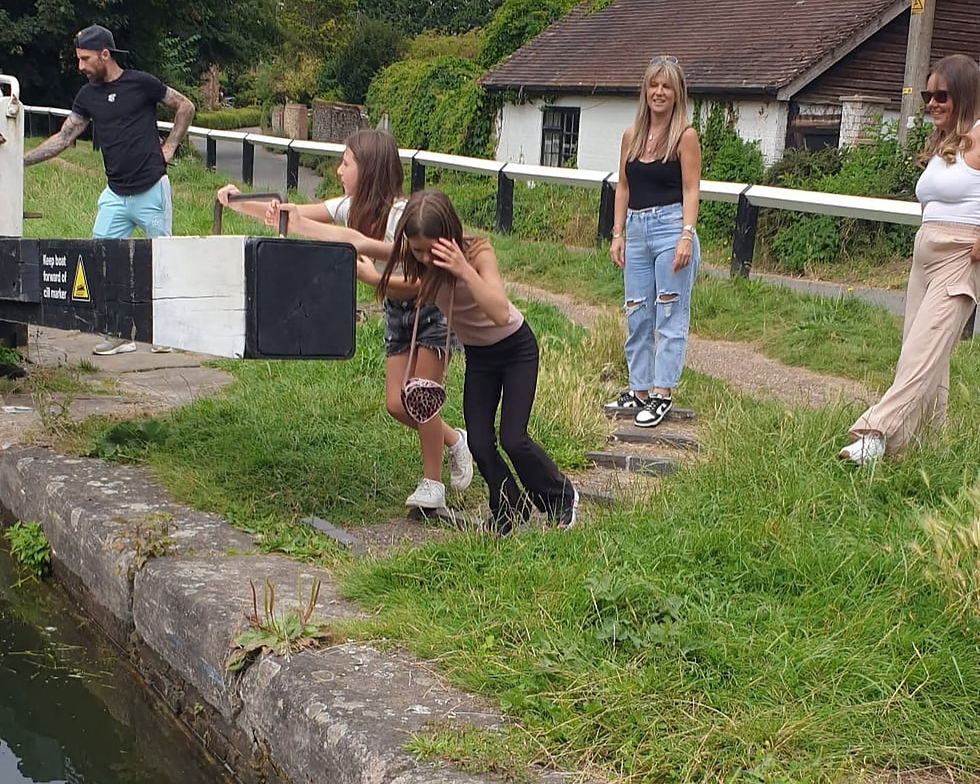
Locks are fascinating for children, but they also involve deep water, large drops and heavy moving equipment.
Children must remain closely supervised and away from the water’s edge, paddle gear and moving lock beams. Depending on their age, they may be able to help with simple tasks under direct adult supervision, but capable adults should handle the heavy equipment.
Even watching the narrowboat rise or fall can feel like a real-life science experiment.
Important Lock Safety Rules
The most important rules are:
Wear one of the provided life jackets around the lock.
Enter and leave slowly.
Keep a competent person aboard.
Watch the narrowboat continuously.
Keep the boat clear of the gates and underwater cill.
Wear practical shoes with good grip.
Keep children closely supervised.
Never leave a windlass attached to the paddle mechanism.
If something looks wrong, close the paddles before resolving it.
Always follow the hands-on training and any instructions or signs provided at the lock.
How Long Does a Lock Take?
Allow approximately 15–20 minutes for each lock, although first-time crews may take a little longer.
Remember that locks completed on the outward journey will usually need to be repeated on the return to Cow Roast Marina. Four locks each way means eight lock operations during the day.
Locks are part of the experience, so there is no reason to rush. Choose a realistic turning point and leave enough time for a relaxed return.
Do You Need Previous Experience?
No boating licence or previous experience is required.
Every hire includes a safety briefing and hands-on tuition before you leave Cow Roast Marina. We will show you how to control the narrowboat, manage the locks and navigate your chosen route safely.
If you would prefer an easier first trip, choose the lock-free northern route. If your crew wants a more active challenge, head south and put your new skills into practice at Cowroast Lock.
You can also read our guide to driving and stopping a narrowboat without panicking.
Make Locks Part of the Adventure
Before the trip, locks are often the part first-time boaters worry about most. Afterwards, they are often the part everyone remembers.
Operating one turns your group from passengers into a crew. You communicate, work together and watch historic engineering come to life around your boat.
Choose a lock-free cruise or head south for a more hands-on adventure—either way, the Grand Union Canal is waiting.


Comments